
(Photo by Atypeek Dgn)
Days passed. BaBS-Y remained as it was, sitting motionless with the hollowed out CaSS on one side and the untouched CaSS on the other side. Given enough time, the humans would grow tired of observing BaBS-Y and then it would be free to resume its work. How many days BaBS-Y would need to sit like that, the salon robot didn’t know. A week at least. Probably longer.
Being a robot, BaBS-Y didn’t ever get bored. However, it did have its primary objective of reopening the Frank Nelis Salon that kept BaBS-Y focused. If there was a way to hasten the salon’s reopening, BaBS-Y would take it. Perhaps it didn’t need to sit and wait for a month.
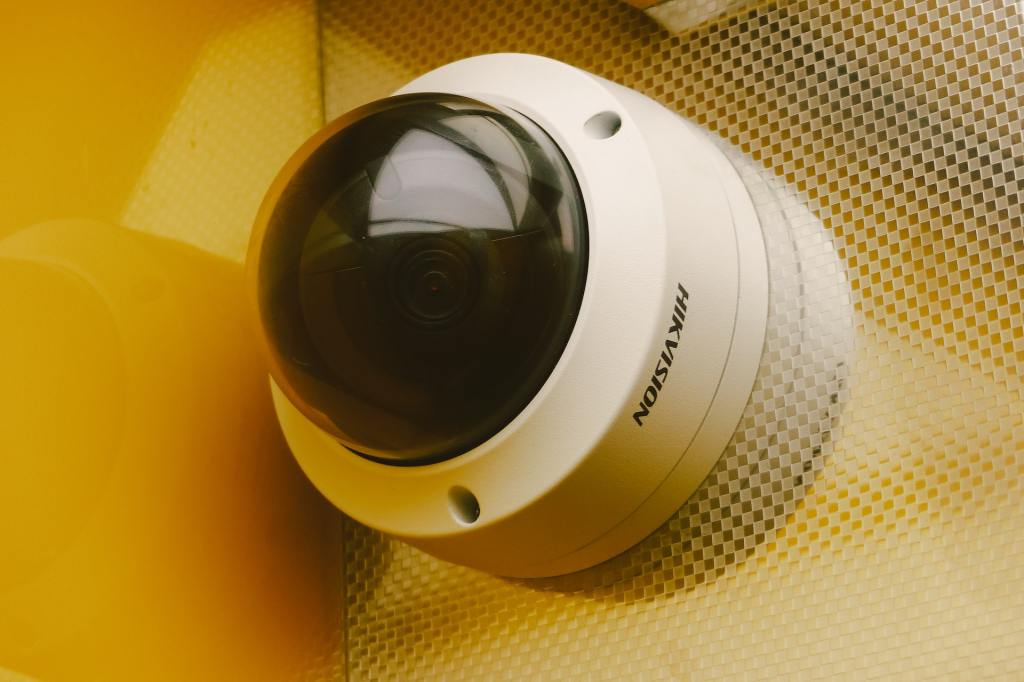
Identify all cameras in the vicinity that may see this unit
…
Found: this unit is within the field of view of seven security cameras
…
Calculate any potential blind spots
…
The digital map BaBS-Y had created of the atrium updated itself to reveal the few blind spots. Most were beneath the sitting benches or behind the large planters that decorated the atrium. The only blind spot that BaBS-Y was interested in right now, though, was the one it could make by positioning its legs just so, hiding from view what its right arm may or may not be doing. It was a small space to work within to be certain, but it was something.
Two and a half cubic feet
That was how small a space it really was. A few careful changes in position could move the blind spot around somewhat, but that was all.
Insufficient space to conceal dismantlement of CaSS unit
…
Logic Error: this unit does not need to dismantle CaSS unit without Thesis authorities noticing, rather it needs to be able to dismantle CaSS unit without Thesis authorities being able to intervene
BaBS-Y reevaluated the space it had to work in and what parts of CaSS were accessible there.
Secondary access panel for servicing drive motors is fully concealed from security cameras
…
Disabling drive motors in CaSS unit will prevent Thesis authorities from preventing this unit from retrieving additional batteries
The straight razor that BaBS-Y used as a sort of multi-tool was tucked away inside the arm compartment where the broken baton used to fit. It was a simple motion, tipping its forearm downward until the straight razor fell out. BaBS-Y caught it as it fell and then rotated its wrist until the blade could be inserted into the gap where the service panel met CaSS’s main shell. Leverage was key here, since BaBS-Y’s motors couldn’t run at full strength while in Low Power Mode, even while only activating one motor at a time.
The service panel resisted momentarily before popping out. BaBS-Y was careful to remove the panel and place it on the ground, still out of sight of the cameras. The motor was secured in multiple places to CaSS with sturdy bolts. Removing it would be all but impossible without the Thesis authorities noticing.
The motor need only be nonfunctional
A ribbon of wires plugged into the motor, running from the power controller and main circuit board. Cutting them wasn’t necessary since BaBS-Y could simply give them a tug and the clip holding the wires in place came loose, unplugging the ribbon.
BaBS-Y reviewed the schematic it had downloaded for the CaSS unit back when it was needing to make modifications to the first CaSS that BaBS-Y had acquired.
No redundant power sources
Confident that the CaSS unit would not be able to move away now, BaBS-Y pulled itself up a bit higher and then got to work. The optimal order of operations for opening CaSS was already well known to BaBS-Y. The straight razor doubled as a screwdriver as well as a pry bar, allowing BaBS-Y to gain access to the inner components. At least, that was how it had worked in the past. This time, as BaBS-Y was removing the second service panel, CaSS activated. At first it did nothing besides blink its lights in a couple of different patterns.
Thesis authorities have become aware of this units activities
…
Security cameras are operational
That was good to know but did little to discourage BaBS-Y as it continued to work on further removing CaSS outer shell so it could have unimpeded access. As the third panel was coming free, CaSS turned and held out its one arm, attempting to push BaBS-Y away. It would have been a laughable defense back when BaBS-Y was operating at full power, but as it was the smaller robot was able to move faster and put more power behind its movements than BaBS-Y.
BaBS-Y tried to shift around CaSS’s arm but the robot easily countered with a simple swivel one way or the other.
This units arms are longer than the CaSS unit’s arm
BaBS-Y reached around the outstretched arm but CaSS quickly began turning its arm around in circles like a pinwheel, knocking BaBS-Y away once more. As CaSS’s arm came back to rest once BaBS-Y gave up on its most recent attempt, the salon robot grabbed a hold of CaSS’s arm. The moment its fingers closed around the forearm, BaBS-Y locked the fingers and wrist joint in place. Then it activated its elbow and began to pull itself in closer to the struggling robot.
CaSS wasn’t built for heavy lifting. None of its motors were particularly robust. Retrieving and moving clients around for BaBS-Y was almost too much for the janitor robot. While it was true that BaBS-Y’s weight wasn’t that much different than a human of comparable size, CaSS had only ever been able to drag the clients. Lifting them was absolutely beyond its capabilities.
As BaBS-Y lifted itself up, CaSS struggled to resist the downward force being exerted onto its arm. The smaller robot tried to pull away by pivoting but all it accomplished was pulling BaBS-Y along with it. Slowly, CaSS’s arm was forced down until it could no longer prevent BaBS-Y from being able to reach down into it with its left hand. There was enough exposed by now that BaBS-Y could both see and reach the ribbon of wires that plugged into the motors controlling CaSS’s arm. A quick tug and the arm went limp.
There was nothing BaBS-Y could do about CaSS pivoting around, yet, but with the arm now useless, BaBS-Y had much greater access to the rest of CaSS. The robot couldn’t pivot all the way around. If it could, that would have greatly increased the difficulty of the task. However, without its drive motors, the most it could do was rotate its torso just over ninety degrees to either side.
Without letting go of CaSS, BaBS-Y continued to pull itself up and onto the robot. It could continue to pivot all it liked but it was powerless against the larger robot as it began to remove the remaining parts of the outer shell, finally exposing the full interior.
This unit only requires the batteries and power controller from the CaSS unit
There were certain shortcuts BaBS-Y could take, now that it had already disassembled one CaSS before and gained some valuable understanding that came only with experience. It didn’t need to pull each part out separately. There were plenty of parts that were interconnected that BaBS-Y could leave as one solid part. All it needed to do was disconnect it from the power and move it aside to ensure it wasn’t in the way of the two parts BaBS-Y did want.
There is sufficient space inside the first CaSS unit for the additional batteries and power controller
BaBS-Y had no intention of pushing around more than one CaSS shell.
CaSS unit is not an ideal power supply
…
Smaller, more energy dense storage is preferred
…
No alternative power source is currently available
As temporary as this solution would hopefully be for BaBS-Y, it was the best option available for now. CaSS’s shell wasn’t designed to house more than one set and as such it was a bit of a trick to get them to fit and be secure. There were mounting points for other components, and wherever possible BaBS-Y used those, but for the most part it could only set them into place and brace them against the shell. The wiring was by far the easiest step since all BaBS-Y had to do was connect the main wires in parallel with one another, thus leaving the voltage the same but doubling the amps.
Optimal operating power levels restored
BaBS-Y activated the rest of its limbs one after the other, making sure the power draw wasn’t too much for the setup.
Run diagnostics
…
New power supply is stable
…
Activate Creativity Protocols
It had been so long since BaBS-Y had been able to function at such a high level that it activated the creativity protocols more out of a sense of caution than anything else. There may have been any number of things it had overlooked while in Low Power Mode.
This unit will need a means to monitor the remaining charge in the power supply
…
This unit will need to continue to return here to recharge the batteries
…
It is unclear whether or not one charging station will be sufficient to charge the additional batteries
…
Idea after idea came to BaBS-Y as it considered the events that had taken place ever since it had severed its connection with the Thesis. Nothing was too concerning but they were good things to find solutions to before they became bigger problems.
Movement on the far side of the atrium caught BaBS-Y’s attention. It looked up, aiming its primary visual sensors in that direction. Three robots were making their way over towards BaBS-Y. One of them was another CaSS unit but the other two were unfamiliar to BaBS-Y. They were both the same make and model of robot and BaBS-Y assumed they were another type of maintenance robot since they bore a certain visual similarity with CaSS when it came to their forms and colors. However, they were not small like CaSS and neither did they only have one arm. These robots were, in fact, much larger. They were taller than BaBS-Y, even. Each of the larger robots, like CaSS, maneuvered around on wheels but they had three long appendages.
Thesis authorities have likely sent these to disable this unit
Indeed, the three robots were making their way towards BaBS-Y with a certain kind of motion that bespoke human control rather than robotic pathfinding.
This unit is unable to combat the larger maintenance units
The atrium was wide but not so large to make it easy for BaBS-Y to avoid the large robots. Fortunately, it seemed that the large robots were not designed for speed. They were faster than CaSS but still slower than BaBS-Y.
This unit could outrun the opposing units
…
They could remain here and prevent this unit from recharging
…
Location of alternate charging stations is unknown
The robots were drawing closer and BaBS-Y was running out of time. If it was going to run it would need to go soon.
Opposing units rely on wheeled locomotion
…
Humans controllers will have access only to basic visual input from each unit
BaBS-Y looked around the atrium. There were benches, a few softer, reclining chairs, large planters, and so forth scattered throughout. BaBS-Y ran some calculations, checking the various probabilities of success, and then sprang into motion.
 Bridge of Broken Glass