
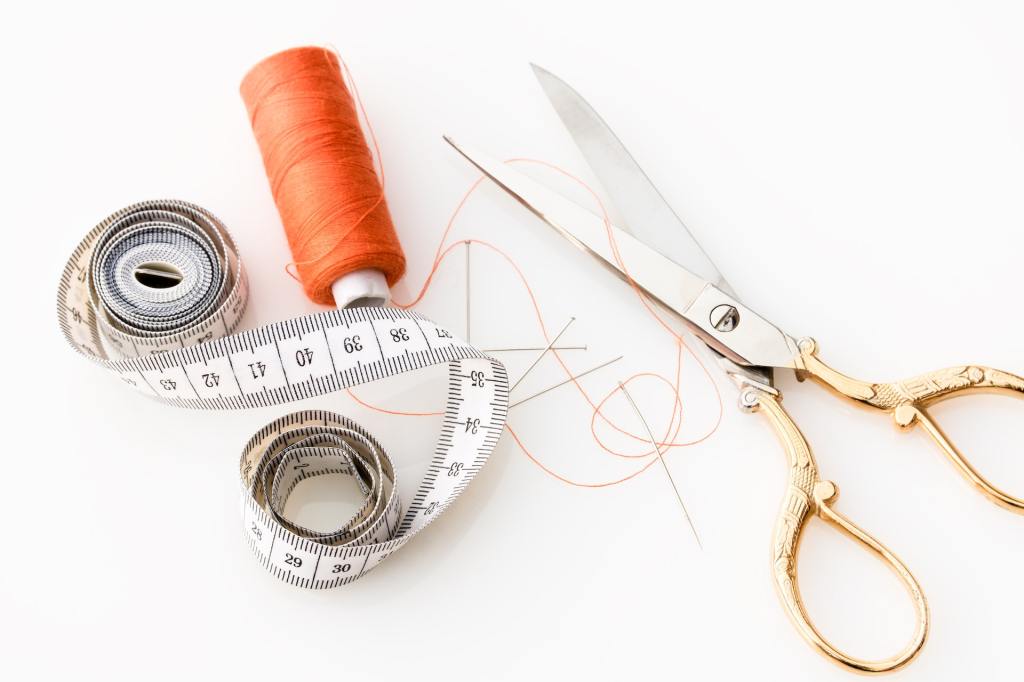
(Photo by Pixabay)
Being a robot meant that BaBS-Y had certain advantages over humans. It didn’t need to eat or breath. Neither was it effected by the temperature as severely as humans were. However, being a robot also meant that there were certain things BaBS-Y could not do. Developing flexibility was just such a shortcoming. If BaBS-Y were human, it could, for example, sit on the floor, the bottoms of its feet together while its knees were spread out to either side. Such a position would have allowed it to hold the cloth it was trying to sew while its one arm worked the needle and thread. As it was, the designers of the BaBS-Y unit did not think such flexible hip joints would be of use to the salon robots.
Hand sewing was not complicated in and of itself. Keeping the fabric in place was the issue. Clips and pins did help to hold the fabric pieces together but the thick cloth resisted any needle being pressed into it and without an opposing force, the fabric tended to slide around. At least threading the needle was simple enough. BaBS-Y just had to poke the needle into a bolt of fabric and then, while the fabric supported the needle, insert the thread through the needle’s eye.
This unit would benefit from a sewing table and clamps
It wasn’t the first time BaBS-Y had noted that fact even though it knew there were no such things on this sector. There were other types of worktables in the sector. Star Jewelry, for example, had a worktable but that one was designed for jewelry making and would be a poor location for BaBS-Y to attempt to sew a hiking backpack. A functioning sewing machine would be the most beneficial but without any available power in this sector besides what was stored in BaBS-Y’s batteries, even that was useless.
BaBS-Y attempted to pierce the fabric once again, coming at it from the side this time. The fabric puckered and creased but ultimately just slid away from BaBS-Y once more. It leaned back, still sitting on the floor, and appraised the problem. It had tried to hold down the fabric with its feet but the lack of flexibility prevented that from working. It had tried poking the fabric from different angles, at different speeds, and with different needles of varying girth.
Everything had been going so smoothly up until this point. BaBS-Y had modified the base schematic to incorporate tailored pouches for the batteries and power controllers, even including space for more batteries if it ever got them from the third CaSS unit. The cloth was easily identified, measured, and cut. Even the aluminum support structure wasn’t that hard to get; part of a chair frame BaBS-Y found was nearly a perfect match for what the original schematic called for. Padding and buckles for the straps were similarly easy to acquire.
This task would be trivial if this unit had 2 functioning arms
BaBS-Y scanned the surrounding area once again. It was in the atrium, back at the charging station so it could work while ensuring its batteries didn’t get too drained. Broken benches and toppled planters littered the area from BaBS-Y’s first encounter with the WaCS units.
An object of sufficient mass, resting on an edge of the fabric would prevent the fabric from moving as freely when sewing
BaBS-Y picked up the pieces it had been struggling to sew together and carried them over to where a planter and a mostly intact bench were laying. The salon robot placed the pieces of cloth, still pinned together, down beside the planter and then rolled the planter over until it was on top of the fabric’s edge. Then it positioned the bench over the end of the other piece of fabric. Immediately BaBS-Y recognized that there wasn’t enough slack for it to get its hand underneath the fabric but that was solved by simply shifting the bench a bit closer to the planter until the fabric was loose enough that BaBS-Y could easily fit its hand beneath it.
BaBS-Y took the threaded needle and began pushing up from beneath on the two pieces of fabric. It pulled tight as BaBS-Y pushed but this time the needle was able to push through. Quickly, BaBS-Y moved it’s hand over to the topside and pulled the needle the rest of the way through. When it tried to push the needle back through, however, the floor was in the way. BaBS-Y wriggled the needle back and forth a bit but it had already tried to sew in that direction and knew it would only result in broken and dulled needles.
With two working hands, BaBS-Y could provide the needed gap by simply having one hand beneath the fabric, propping it up. It looked back at it’s broken arm, laying beside the charging station with the unused CaSS components.
This unit’s hand would only need to rest beneath the cloth in order to allow the needle to pass through the fabric
…
This unit’s hand would not need to be functional in order to fulfill that roll
BaBS-Y retrieved its arm and slid it under the fabric, placing the hand roughly where it needed the needle to pass through. It took a few tries and some repositioning of the arm and hand to get it just right, but soon BaBS-Y found itself with the first seam done. Each subsequent seam was faster then the one before it as BaBS-Y continued to refine its process.
As the day wore on and evening approached, BaBS-Y finished sewing the backpack. Moving the batteries and power controllers into their individual compartments was a slow and careful procedure but once they were in place, BaBS-Y slung the backpack on, buckled the chest and waist straps into place, and then slid the excess power tether into the main pouch of the backpack.
The one real problem with the backpack was the fact that it was designed with two arms in mind to anchor the shoulder straps and BaBS-Y only had the one. The chest strap certainly helped to keep the shoulder strap from just slipping off immediately but BaBS-Y went ahead and added another strap, this one crossing down from the shoulder to the opposite hip to ensure the shoulder strap was secure.
Satisfied with the construction, BaBS-Y fastened the backpack into place, adjusting the straps as needed, and then began to move about while keeping a careful eye on how the batteries, power controllers, and wires all handled the motion. Losing a connection would be disastrous. The first motions were slow and careful. BaBS-Y bent and twisted, leaned from one side to the other, sat down and stood back up. Then it moved on to more vigorous movements like walking and even jogging. Finally it ran around a bit, jumped up and down, and was overall pleased with how well everything was working. The backpack was sturdy and moved with BaBS-Y which in turn kept everything from jostling around.
The charge indicator for the batteries was now positioned on the shoulder strap where BaBS-Y could easily see it. The current reading was only 35%.
This unit should have moved the planter and bench nearer to the charging station so that this unit would not have drained its batteries
There was still enough of a charge that it could go and see how the other robots handled CaSS’s charging but if anything went wrong and BaBS-Y needed to really run for it, such a sudden draw of power might fully drain the batteries before BaBS-Y could make it back to the charging station.
This unit will resume creation of new programs for observing the Thesis authority’s efforts to repair the damaged sectors
That was, after all, higher on its priorities. If BaBS-Y could just figure out what they were doing then it could begin coming up with options for how to stop them. As the listed manager of the Frank Nelis Salon, BaBS-Y had access to certain pieces of information that it wouldn’t otherwise be privy to, such as the updated instructions to the robots and the repair orders. However, that level of permissions only granted basic information. BaBS-Y knew there were repairs being done but not what those repairs were specifically or what materials were being used.
It was a safe bet that any attempt to gain access to things like security cameras would trigger some sort of alarm or other safety measures, but there were other things that might not be so well protected.
Begin writing new program: Thesis Inventory Use by Sector
Begin writing new program: Thesis Power Use by Sector
Begin writing new program: Thesis Personnel Work Assignments
 Bridge of Broken Glass