
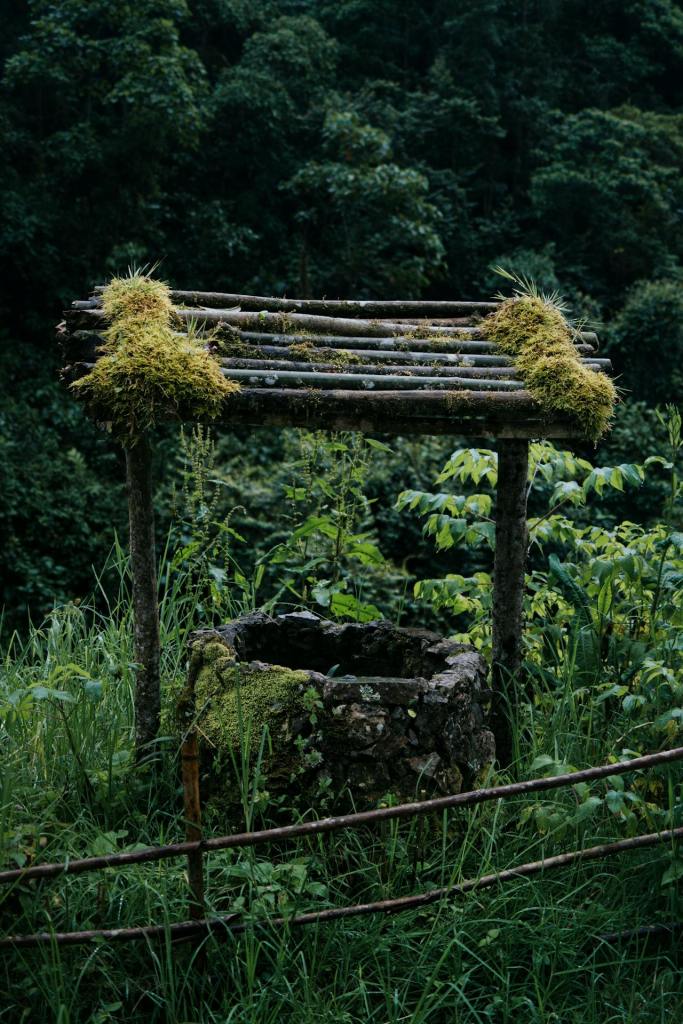
(Photo by Jhonny Salas Brochero)
There were two wells in the narrow valley but only one was used to draw water these days. It wasn’t unheard of for a well to eventually run dry, although that wasn’t the reason why the other well was left unused. It was technically closer to the village, though the steep and uneven pathway that led to it made the trek somewhat more difficult. For that and other reasons, the village drew their water from the well slightly farther away.
All that isn’t to say that no one ever went to the other well. It was simply less frequent to the point where the path was beginning to disappear as nature worked to reclaim it. In the last couple of generations the villagers had begun referring to the well they all drew water from as ‘the well’ and to the other one as the old well. No one actually knew which well was older but details like that weren’t important to the people who lived in the valley.
A few times each year, someone from the village would make the short hike up to the old well. No one ever commented on it but the entire village always seemed to hold its breath until whoever had gone to the old well returned. Even less common, though still not unheard of, were the outsiders who came to see the old well. Some of them already knew the way to the well while most needed to ask for directions. There was never any confusion among the villagers regarding which well those outsiders were looking for and they had no reason to try and hide its whereabouts. The only thing the villagers wanted was for whoever visited the well to abide by the rules, which were ‘Don’t throw anything in that shouldn’t go in the well’ and ‘Don’t take anything from the well that isn’t yours to take’.
Thankfully, the villagers never needed to deal with the rule breakers. Those were the ones who never returned from their visit to the old well. At least, that’s what most of the villagers assumed and, on the whole, they were generally correct.
As autumn waned and winter began to loom near to the valley, the trees shed their leaves which covered all but the most well traveled roads. The frosty mornings were quiet as people waited indoors for the sun to rise and impart whatever warmth it could to their village before they began their daily chores. The only exceptions were, of course, the baker’s family and the family that owned the only milking cows. They had to be up early regardless of the weather. Their children thought this was a rather unfair state of affairs but the inertia of generations was too great for their youthful complaints to sway the older members of their families.
It was those two families, up earlier than everyone else, who saw the stranger walk through the village, his head turning this way and that as he looked up into the hills on either side, searching. The villagers who watched the stranger all had roughly the same conversation.
“Who’s that?”
“Never seen him before.”
“Think he’s looking for the old well?”
“Can’t think why else he’d be here.”
“Better send someone out to give him directions.”
Each family sent a runner to do just that. The baker sent her youngest son who had been complaining loudly that morning about how early it was.
“The cold’ll wake you up,” she said firmly, “and maybe when you get back you’ll stop complaining about being tired.”
The milkers sent their middle child for similar reasons.
“You can run all the way there and all the way back and that should warm you up plenty.”
The young girl pouted but to no avail and soon she was running off towards the stranger at the same time as the bakers son stepped outside. They both arrived at about the same time, waving to the stranger to get his attention.
“Hello, sorry, I thought everyone would still be asleep,” the stranger said when the two youths reached him. “I hope I didn’t wake anyone.”
“You’re here for the old well?” the baker’s son asked, cutting straight to the point in the hopes of being able to get back inside where it was warm with the smells of fresh dough and baking bread. “It’s just up there.” He pointed to where the trail began, although it was fairly well hidden beneath the fallen leaves.
The stranger’s gaze followed to where the boy was pointing but didn’t move to go in that direction just yet.
“The trails hard to see but it’s there,” the milker’s daughter assured the stranger. “There’s notches in the tree’s bark all along the path. You’ll see it once you get closer.”
“Yeah,” the baker’s son agreed. “Just don’t throw anything into the well that shouldn’t be there, and don’t take anything that isn’t yours.”
Their job done, the two turned and hurried off back, the boy to the bakery and the girl to the milking barn. The stranger stayed where he was, looking to where the boy had pointed out the trail head and shifting his weight uneasily.
“Maybe he isn’t here for the old well,” the watchers mused.
“Why else would he be here?”
“Maybe he still doesn’t see the path.”
“Go on back out there and walk him over to it, otherwise he’ll just stand there all day like a blind mule.”
Both youths reappeared outside, looking impatient and upset.
“Are you here for the old well or not?” the milker’s daughter asked when she reached the stranger.
“I am, I guess,” the stranger replied.
“Come on then,” the baker’s son said and pulled the stranger along by the hand.
The three of them walked over the where the village clearing ended and the forest began. The opening in the underbrush was hard to see since it was much less of an opening these days and more like a slightly less bramble filled patch.
“See those markings?” the milker’s daughter asked while pointing the first such marking out on the nearest tree. The scar on the bark was in the shape of an oval with three horizontal lines above it. “You can follow those all the way up to the old well.”
“Okay,” the stranger said with obvious uncertainty in his voice. He even looked back across the way he’d come and up to the other side of the valley. “There’s two wells in this village, yes?”
The two youths exchanged weary glances and rolled their eyes.
“Yes,” they said in unison.
“But that well is where we draw our water,” the milker’s daughter said, gesturing off towards the well on the other side of the village.
“Could I see that one first?” the stranger asked.
“Only if you’re thirsty,” the baker’s son replied. “All it’s good for is drawing water.”
“No one ever draws water from this one?” the stranger asked, earning himself another incredulous look from his two guides.
“Nope.”
“Never.”
“Then why does it matter what people throw into it?”
The two youths couldn’t think of any reason to give besides the obvious fact that you just didn’t throw random trash or whatever into a well, regardless of whether or not you used it. It was like kicking a cow that didn’t belong to you, or cutting down a wild fruit tree. Just because you didn’t use it didn’t mean you could just go and ruin it.
“Look,” the baker’s son said, “we’ll take you to either well, both if you really want to, but make up your mind.”
The stranger obviously had a hard time making decisions, or perhaps he was simply nervous. A lot of people who came to see the old well acted nervous. When another handful of seconds passed by without the stranger making up his mind, the baker’s son and the milker’s daughter took the stranger by the hand and began towing him back across the village and towards the well.
Ten minutes later they were standing in front of a low stone structure, covered over by a pair of overlapping wooden doors. The milker’s daughter pulled the top door back and lowered the bucket. When she pulled it back up it was full of clear water. The stranger removed a small cup from his pack and accepted a drink.
“Ooh, that’s cold,” he said with surprise and making a sucking sound through his teeth to warm them up after finishing his drink.
“It’s well water,” the baker’s son said, shaking his head. “What did you expect?”
“Come on,” the milker’s daughter said impatiently after closing the well back up. “Let’s get to the old well.”
The three of them crossed the village yet again. The path up to the old well was difficult to traverse and it took them close to half an hour to reach the old well. It looked almost identical to the other well, with two notable exceptions. The first was the overgrowth that clogged the area around the well. The second difference was the pile of coins that filled the well, overflowing and spilling onto the ground, preventing the cover from being put back into place.
The two youths were obviously unimpressed by the small fortune of coins but the stranger was having a difficult time looking at anything else.
“This…this is,” he stammered, “does anyone in your village realize how much is up here?”
“Don’t take anything that isn’t yours,” the two said in unison.
“But none of it belongs to anyone,” the stranger said, as though trying to convince himself as well as the two youths.
That was more than enough to convince the two that it was time for them to go. Without a word, the baker’s son turned on his heels and began walking back down the way they’d come. The milker’s daughter only stayed long enough to give the stranger one last warning.
“It doesn’t belong to us,” she said, “and it doesn’t belong to you either.”
With that, they were both gone and the stranger was alone at the old well, staring at the hundreds, the thousands of coins that had been amassed over the countless years. People coming here over and over to toss in a coin. To make a wish. Until the well became so clogged with wealth that it no longer functioned as a well.
Making a wish was understandable in certain circumstances, when nothing short of a miracle would solve a specific problem, but the stranger’s problems weren’t in need of a miracle. No, he was in need of money. Plain and simple.
He waited a few more minutes to ensure the two youths from the village were gone before stooping down and filling his pockets with as many coins as he could. As soon as his pockets were full he began filling his pack, pouring handful after handful of glittering coins into it.
How could an entire village be so foolish? To have this much wealth within such easy grasp and not to take it was insanity. Though, he supposed that they must just be a superstitious lot.
The coins were cold, frosted over in many cases but he didn’t care. However, as he grabbed more and more of the coins he couldn’t help but notice just how much the cold metal was beginning to bite and sting his hands. At first it was an annoyance, but soon it began to truly hurt. It was then, as he moved to rub his hands together to warm them up that he noticed the blood. Dozens of tiny cuts had lacerated the flesh of his hands. What was more was the fact that the tips of his fingers were turning black from frostbite.
“How…?” he gasped aloud at the shock of how badly injured he was.
Now that he was fully aware of his injuries the pain became intense. He had nothing to bandage his injured hands with, and even if he did he doubted he had the dexterity needed to do a proper job of it.
He looked over the pile of coins and saw that he hadn’t yet managed to make much of a dent in it. The pile of coins didn’t even appear to have been disturbed, with the leaves and frost still covering everything.
“It’s okay,” he assured himself. “I should have enough now anyway.”
He got up to his feet, patting his pockets to reassure himself, only to find that they were empty. He double checked them, and then his pack, but there were no coins.
“What did you expect?” a voice said from behind.
The stranger turned, startled and ready to give the villager an apology before asking for help binding their wounds. There was no one there, though. He looked around again but as far as he could tell he was alone. Perhaps the superstitions around this well weren’t made up after all.
“All right, I’m sorry,” he said to the empty air. “I was wrong and I’ve clearly been fairly punished for it. I’ll just leave and not bother you again.”
He took a step to do just that but his foot caught on a bramble, tripping him up. He began to fall so he tried to bring his other foot around to catch himself but that one got snagged on a root, spinning him even as he fell, bringing him around to land face first in the pile of gold coins that filled the old well. The cold metal bit into him at once and he scrambled to get up. Unfortunately, he didn’t seem to stop falling after hitting the coins. Instead he fell through them as though they were water, their sharp, frosted edges continuing to cut him as he struggled, trying to swim now against the downward pull.
Coins pressed up against his mouth, threatening to flood inside if he tried to call out for help. That worry only lasted a moment and was replaced with a new worry as soon as he hit the water. Now the cold soaked though his layers of clothing and bit right down to his skin, to his bones. He couldn’t see. Couldn’t breathe.
How could this be going so wrong? This was supposed to be an easy solution, an unguarded treasure, preserved by superstition and tradition. The wishing well that only sometimes seemed to grant its petitioners their wishes. Such a fickle benefactor sounded more like luck and self-fulfilling prophecy than anything else.
His vision began to close in around him and his body no longer responded as it ought to have done as he tried to swim back up to the surface.
Down in the village, the baker’s son and milker’s daughter waited for the stranger to return. The two weren’t all that surprised when he failed to reappear but still they kept stealing glances towards the trail head, wondering if they’d see him again.
“There’s chores still to do,” the two youths were finally told. “Get to it. The old well will take care of itself. None of our business one way or another what happened to that man.”
The stranger’s visit was commented on and the story spread throughout the rest of the village but no one went up to check on the old well. There was no need. The old well always took care of itself.
 Bridge of Broken Glass